
List of Amazon Sellers in the USA: Why Marketplace Presence Is Not Business Location

Of 38,088 Amazon.com sellers The Sellers Index tracks, 72.1% are China-based and only 19.8% are genuinely US-based. A naive list of Amazon sellers in the USA returns mostly Chinese-origin businesses. Here is how to verify by base country.
List of Amazon Sellers in USA: Why Marketplace Presence Is Not Business Location
- Start from Amazon.com, not a generic seller export: 38,088 sellers on that marketplace are the addressable universe.
- Reject marketplace presence as a proxy for location — 72.1% of Amazon.com sellers are China-based, not American.
- Filter on a verified base-country field: only 19.8% (7,545 sellers) resolve to a genuine US business location.
- Confirm legal identity against the registered legal name, not the public storefront display name.
- Apply the 11-field verification standard so each US record carries a base country, US state and revenue band.
- Cross-check against INFORM Consumers Act disclosures, which Amazon must verify for high-volume third-party sellers.
- Refresh the list on a 30-day cycle so dormant or relocated sellers fall out automatically.
The 72.1% reality: most Amazon.com sellers are not American
Of the 38,088 sellers The Sellers Index tracks on Amazon.com, 72.1% (27,462) are China-based and only 19.8% (7,545) are genuinely US-based, with roughly 8.1% from other origins.
This is the single fact that breaks a naive list of Amazon sellers in the USA. The phrase "sellers in the USA" is ambiguous: it can mean sellers visible on the US marketplace, or sellers headquartered as US businesses. Those are very different populations. Because Amazon.com is the world's largest marketplace, sellers from every country list there, and Chinese-origin businesses now outnumber American ones by more than three to one on that single storefront. Marketplace Pulse reports Amazon passing six million third-party sellers worldwide, so the absolute count is enormous — but volume is not the problem. The problem is composition. Scrape storefronts and label everything "US", and you build a directory in which roughly seven of every ten records is a Chinese business. For a genuine American list, the number that matters is 7,545, not 38,088.
Marketplace presence versus base country: the core verification problem
Marketplace presence tells you where a seller sells; base country tells you where the business actually operates — and only the second can anchor a US seller list.
The two signals diverge constantly. A storefront's "Sold by" address can show a US forwarding agent, a Delaware registered office or a shell entity while the operating company sits in Shenzhen. Amazon's business-information panel surfaces a registered name and address, but a registered US presence is a filing, not a place of business. Verification means resolving each seller to a base country through corroborating evidence — the registered legal name, a tax or registry reference and a documented address — then reconciling them so a single US filing cannot reclassify a Chinese operator as American. Against the scale of US e-commerce, which the US Census Bureau measures in hundreds of billions of dollars per quarter, the origin question is material. That is why a verified figure of 7,545 US sellers should always sit below a scraped count of 38,088: the gap measures how much origin noise a naive list carries.
The INFORM Consumers Act: the US federal backdrop to seller identity
The INFORM Consumers Act, enforced by the Federal Trade Commission since 27 June 2023, requires online marketplaces to collect and verify identity information for every high-volume third-party seller.
Under the Act, a high-volume seller is any account with 200 or more transactions and at least $5,000 in gross revenue in a continuous 12-month period. For those sellers, the FTC requires Amazon to collect a bank account, contact details and a tax identification number, verify them within ten days, and disclose the seller's name and address to consumers on the listing. This matters for list-building in two ways. First, it confirms that seller identity on Amazon.com is now a regulated, verifiable attribute — not an optional courtesy. Second, the consumer-facing disclosures give a public reference point against which a base-country claim can be cross-checked. The Act does not, however, separate American sellers from foreign ones; it verifies that a seller is who it says it is, wherever it sits. Distinguishing a genuinely US business still depends on independent base-country enrichment layered on top of the regulatory baseline.
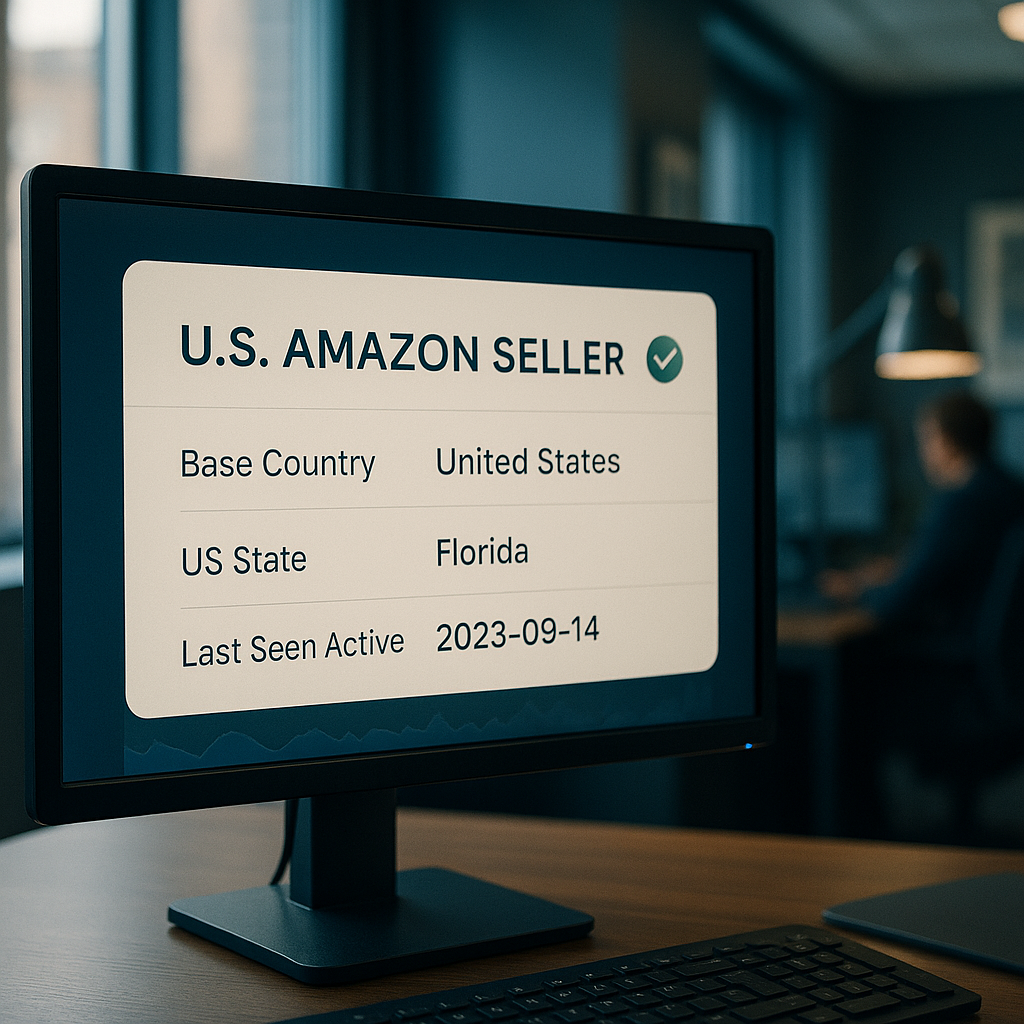
The 11-field verification standard applied to US sellers
The Sellers Index applies an 11-field verification standard to every record, and 4,840 of its US-marketplace sellers are already verified-enriched to that level.
The eleven fields are a verified business email, trading name, registered legal name, VAT number (VIES-checked where applicable), a Companies House or equivalent registry reference, base country, the active marketplace list, primary product categories, a revenue band, the last-seen-active date and an email-ready business summary. Applied to a US seller, this stack converts a storefront name into an addressable American company: base country pins the business to the United States, the registry reference and legal name confirm the entity, and the revenue band signals whether the seller crosses the INFORM Consumers Act high-volume threshold. The same enrichment underpins our verified Amazon seller leads and the broader Amazon seller data intelligence layer. A list that carries only a name and a storefront URL cannot be segmented, deduplicated or compliance-checked; a list carrying eleven verified fields can. Of 4,840 verified-enriched US records, every one survives base-country reconciliation rather than inheriting an origin from a scraped header.
How to segment and refresh a US seller list on a 30-day cycle
A verified US seller list is refreshed on a 30-day cycle so that relocated, dormant or deactivated sellers drop out before they pollute outreach.
Segmentation comes first: filter the 7,545 US-based sellers by US state, primary product category and revenue band to match a specific use case, whether that is an aggregator hunting acquisition targets or an agency pitching American brands. The last-seen-active date then governs freshness — a seller absent across a refresh window is flagged, and accounts deactivated under INFORM Consumers Act non-compliance fall away automatically. The Sellers Index re-verifies records every 30 days, so base-country, revenue-band and activity fields reflect the current marketplace rather than a stale snapshot. Pricing runs from £1.25 to £5.00 per lead, with detail published on our Amazon seller data pricing page, and the wider origin picture is documented in our State of Amazon Sellers 2026 report. The discipline is the opposite of a one-off scrape: a US list is a maintained asset whose value is its verified composition, not its raw size.
Watch the explainer
This short walkthrough shows how to read a storefront's signals to judge whether an Amazon seller is genuinely US-based or China-based — the same distinction our base-country field automates at scale.
A practical demonstration of why marketplace presence alone cannot tell you where an Amazon seller's business actually operates.
Frequently asked questions
How many Amazon sellers are genuinely based in the USA?
Of the 38,088 Amazon.com sellers The Sellers Index tracks, only 19.8% — 7,545 sellers — are genuinely US-based. The majority, 72.1% (27,462), are China-based businesses trading on the US marketplace rather than American companies.
Why does a list of Amazon sellers in the USA mostly return Chinese sellers?
Because marketplace presence is not business location. Any seller worldwide can list on Amazon.com, and 72.1% of those sellers are China-based. A list filtered only on US-marketplace visibility therefore returns mostly Chinese-origin businesses unless base country is verified.
What is base-country verification for Amazon sellers?
Base-country verification resolves a seller to where its business actually operates, using the registered legal name, a registry or tax reference and a documented address. It treats base country as an independently checked field, not a value copied from a storefront's display address.
Does the INFORM Consumers Act identify US-based sellers?
No. The INFORM Consumers Act requires Amazon to verify the identity of high-volume third-party sellers — those with 200-plus transactions and $5,000-plus revenue in 12 months — but it does not separate American businesses from foreign ones. Distinguishing US sellers needs additional base-country enrichment.
What fields should a verified US Amazon seller record contain?
A verified US record should carry all 11 enriched fields: verified email, trading name, registered legal name, VAT or tax reference, registry reference, base country, active marketplaces, product categories, revenue band, last-seen-active date and a business summary. The Sellers Index has 4,840 such verified US records.
How often should a US Amazon seller list be refreshed?
A US seller list should be refreshed every 30 days. The Sellers Index re-verifies records on a 30-day cycle so relocated, dormant or deactivated sellers drop out, keeping base-country, revenue-band and activity fields aligned with the live marketplace.
Build a list of genuinely US-based Amazon sellers, verified by base country
Get 4 verified sellers for free today.